

The United Nations General Assembly has adopted the United Nations Convention on Negotiable Cargo Documents (NCD), a landmark international legal instrument developed by the United Nations Commission on International Trade Law (UNCITRAL) to modernise global trade and transport documentation across all modes of transport.
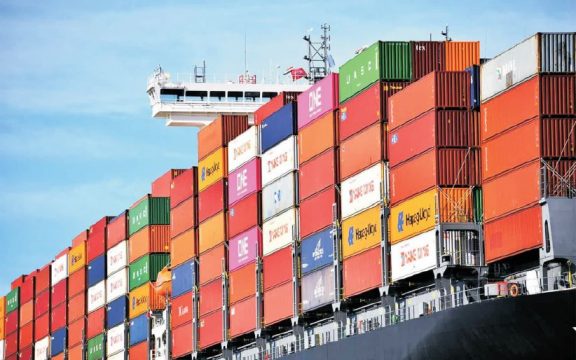
The Convention, adopted on 15 December 2025, extends the long-established benefits of maritime bills of lading to road, rail, air, and multimodal transport. For the first time, goods transported across international supply chains can be represented by a single negotiable cargo document, issued in either paper or electronic form, covering the entire journey from origin to final destination.
The Convention introduces a harmonised legal framework that enables goods to be bought, sold, or used as collateral while in transit, thereby improving access to trade finance and facilitating the uninterrupted movement of cargo even when transport routes or modes change. By consolidating multiple documents into a single negotiable instrument, the Convention is expected to reduce administrative burdens, accelerate customs clearance, and lower overall trade and logistics costs.
 A core innovation of the Convention is its support for the digitalisation of trade, as it accords full legal recognition to electronic negotiable cargo documents, granting them the same legal effect as traditional paper documents. This advancement aligns with global efforts to promote paperless trade, supply chain resilience, and sustainable logistics systems.
In adopting the Convention, the United Nations General Assembly authorised a formal signing ceremony to be held in the second half of 2026 in Accra, Ghana, at which time the Convention will be opened for signature by States and regional economic integration organisations. The Assembly further called on Governments seeking to modernise their legal frameworks on negotiable transport documents to consider becoming Parties to the Convention.
The resolution emphasised that a sound legal framework for negotiable cargo documents will reduce trade costs along inland routes and assist landlocked countries and countries with extensive mainland territories to integrate more effectively into global supply chains. It also highlighted the Convention’s role in supporting the digitisation of negotiable transport documents for both coastal and non-coastal States.
The Ghana Shippers’ Authority (GSA) actively participated in the work of the UNCITRAL Working Group that developed the Convention, contributing to technical deliberations aimed at ensuring that the instrument responds to the practical realities of shippers, particularly in developing, transit, and landlocked economies. GSA’s engagement reflects Ghana’s commitment to shaping international trade rules that promote efficiency, inclusivity, and trade facilitation, in line with its mandate to promote efficiency and competitiveness in Ghana’s commercial shipping industry.
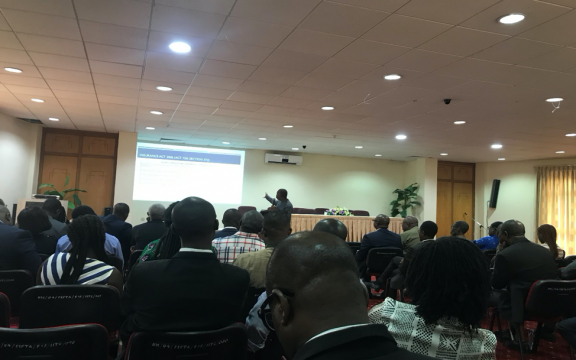
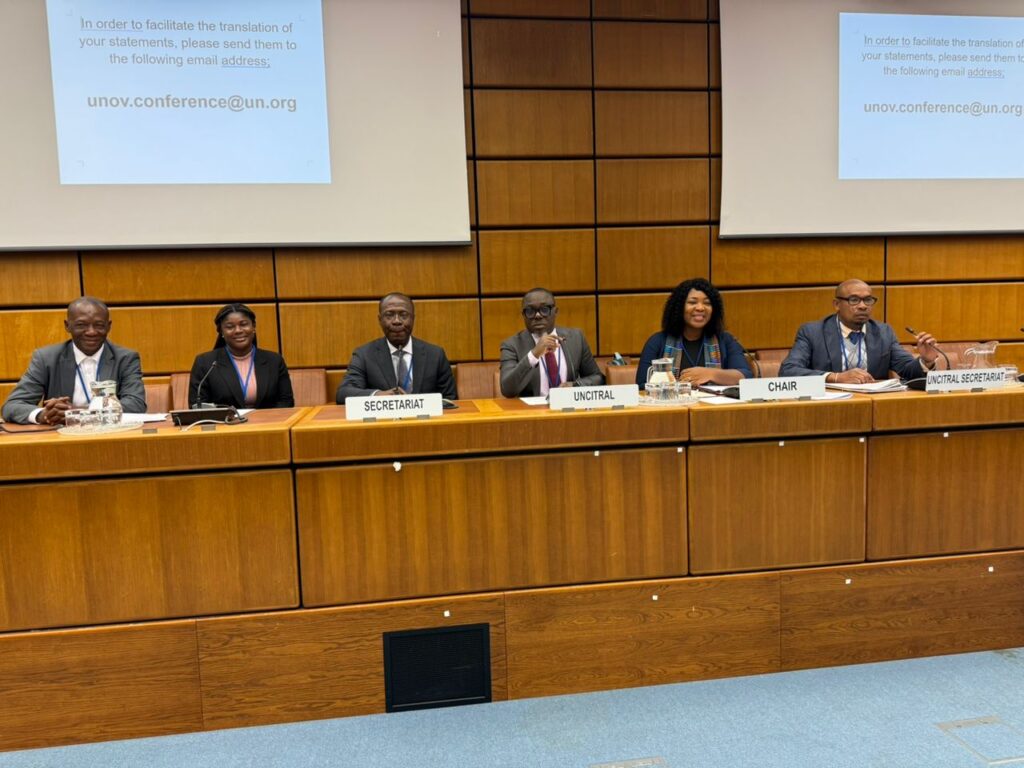
At the 47th meeting of the UNCILTRAL Working Group VI held in Vienna, Austria, from December 15-19, 2025, Professor Ransford Gyampo, Chief Executive Officer of the Ghana Shippers’ Authority, led Ghana’s delegation to finalize the explanatory notes on the new Convention.
Commenting on the adoption of the Convention and Ghana’s role as host of the signing ceremony, the Minister Plenipotentiary, of the Embassy of Ghana & Permanent Mission to the UN Offices in Vienna Austria, Mr. Paul Kwabena Nana Sei Osei stated:
“Ghana recognizes the NCD as a landmark legal instrument that will enhance international trade facilitation through the digitalization of unified transport documents. As such, hosting the signing ceremony, together with a regional sensitization conference in the second half of 2026 in Accra, will not only underscore Ghana’s leadership in advancing legal harmonization and digital trade in Africa and beyond, but also increase awareness, inclusivity and enhance regional engagement. Ghana is indeed pleased to be part of this history-making event.”
The Convention is expected to deliver significant benefits to a wide range of stakeholders across the global supply chain, including micro-, small- and medium-sized enterprises, transport and logistics operators, banks and insurers, digital trade platforms, and customs and border authorities. These benefits are particularly relevant for African economies and align closely with the objectives of the African Continental Free Trade Area (AfCFTA) and the WTO Trade Facilitation Agreement.
The adoption of the United Nations Convention on Negotiable Cargo Documents represents a transformative development in international trade law and reinforces Ghana’s growing role in advancing trade facilitation, legal harmonisation, and digital trade at the global and regional levels.