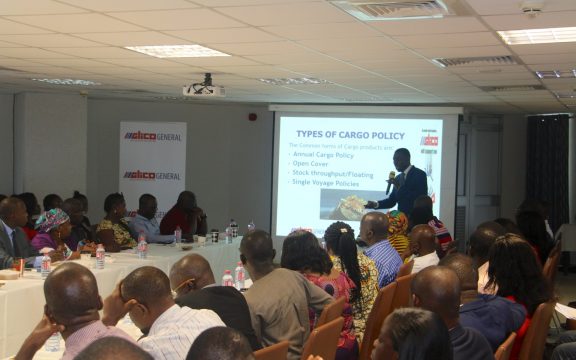

The Chief Executive Officer of the Ghana Shippers’ Authority, Prof. Ransford Gyampo, has urged importers and key stakeholders to comply with the government’s directive requiring all cargo imports to be insured locally, describing the move as key to strengthening the economy and protecting shippers.
Speaking at a high-level stakeholder meeting with officials from the Ministry of Finance, the National Insurance Commission, insurers, and shippers, Prof. Gyampo said the directive, which took effect on February 1, 2026, marks a major shift in Ghana’s trade and insurance space.
 “This collaboration is a significant and strategic step,” Prof. Gyampo said, “toward creating a platform through which our valued shippers can be better informed and sensitised on current issues affecting international trade cargo, particularly local cargo insurance.”
The directive, issued by the Ministry of Finance and enforced by the Ghana Revenue Authority (GRA) in collaboration with the National Insurance Commission (NIC), requires that all imported goods except personal effects be insured locally in accordance with Section 222 of the Insurance Act, 2021 (Act 1061).
 Prof. Gyampo indicated that the policy is designed to curb capital flight, strengthen Ghana’s insurance sector, and retain premium income within the domestic economy.
“This directive represents a decisive policy shift aimed at deepening Ghana’s domestic insurance market, protecting shippers, retaining insurance premiums within our economy, and strengthening sustainable industry growth,” he said.
Providing historical context, Prof. Gyampo noted that a Marine Cargo Insurance Protocol, signed in December 2020 by key stakeholder institutions, was introduced to enhance compliance with local insurance requirements. Despite this intervention, uptake has remained notably low.
He indicated that research conducted at the time revealed that only about 6 percent of imports were insured locally, while approximately 75 percent of importers had limited or no awareness of the insurance coverage on their cargo.
 He noted that this situation exposed importers to significant risks and contributed to financial losses through premiums paid to foreign insurers.
At the engagement, insurance consultant Gertrude Adwoa Ohene Asienim (FICS) delivered a presentation highlighting both the legal and practical significance of procuring local cargo insurance.
She further explained that importers who insure their cargo externally often face several challenges, including difficulty in securing the appropriate value for their policies, lack of a direct relationship with insurers, and communication barriers. She added that such practice also exert pressure on the Ghana cedi due to increased foreign exchange outflows.
She noted that insuring cargo locally offers significant advantages, including prompt claims settlement, protection under Ghanaian law, improved communication with insurers, and reduced exposure to foreign exchange risks.
She therefore urged importers to comply with the directive, emphasizing that adherence would help minimize avoidable financial losses and strengthen the overall efficiency of the local insurance framework.
Stakeholders actively participated in the engagement, seeking clarification on various aspects of the policy, including compliance requirements, documentation procedures, premium determination, claims and compensation processes, enforcement mechanisms, and the roles of key regulatory institutions. Discussions also explored the practical implications of the policy for importers, exporters, and freight forwarders.
Participants further requested additional insight on the integration of the policy with existing customs clearance systems, implementation timelines, penalties for non-compliance, dispute resolution mechanisms, coverage limits, risk assessment processes, and the responsibilities of insurance brokers and shipping agents under the framework.
 The engagement reflects a growing commitment among stakeholders to align Ghana’s trade practices with national economic priorities, and to enhace resilience and efficiency within both the shipping and insurance sectors.